
Toothlessness: have you ever stopped being able to crack an apple?
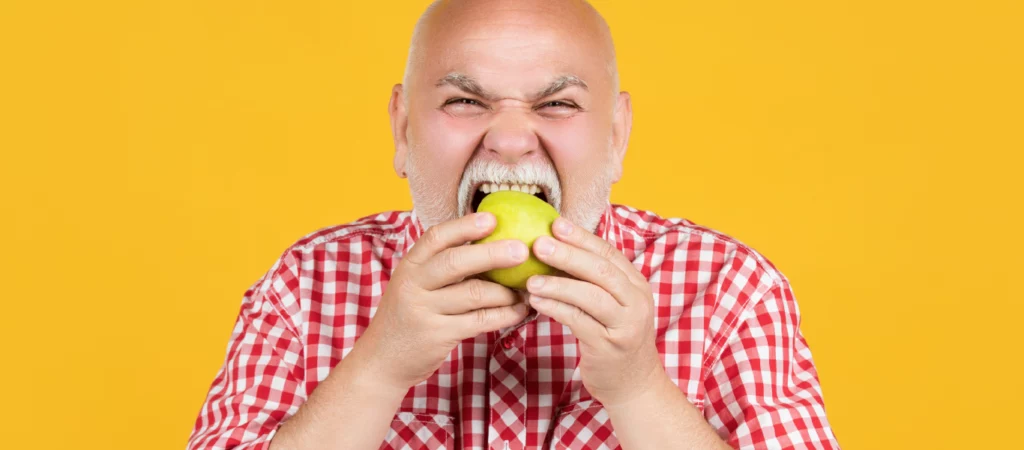
In Vila Franca de Xira, there are traditions and moments at the table that are part of the local identity. But there is a reality that can go unnoticed: many people fail to fully enjoy these moments, not because of lack of appetite, but by difficulty in chewing, mostly due to loss of teeth.
Something as simple as cracking an apple can become a challenge, and with it you lose not only the ability to chew but also the pleasure of eating.
In fact, the problem of toothlessness is not just not being able to eat certain foods, but also not enjoying them as before.
Learn, right away, how to enjoy the flavors back on the table and heal chewing difficulties.
Contents approached
Tooth deprivation: consequences that evolve over time
Dental loss does not only affect the time of meal and is asserted as a silent but continuous process.
Many consider it normal to have difficulty chewing with few teeth, don’t be one of those. Although many people adapt, difficulty in chewing indicates impaired function and can impact diet, digestion, and oral health.
Many consider it normal to have difficulty chewing with few teeth, but one should not devalue.
For many patients, this limitation becomes evident in simple foods (such as a richer fruit, for example an apple) indicating a compromised masticatory function with impact on diet, digestion and oral health.
Over time, it can lead to overloading of remaining teeth; changes in chewing; progressive bone loss; and compromise of facial structure.
The data of the Barometer of Oral Health 2025 confirm that six out of ten Portuguese do not have complete dentition, that is, suffer from the consequences of missing teeth.
Oral rehabilitation: return to eating with comfort
Fortunately, nowadays there are treatments that allow you to recover the masticatory function in a predictable way.
It is no wonder that oral rehabilitation is concerned with the recovery of each patient’s function and aesthetics. Its goal is:
- Restore the ability to chew
- Rebalance the bite
- Improve comfort when eating
- Preserve the bone
- Difficulty in chewing food
- Changes in diet
- Digestive problems
- Progressive bone loss
- Overload of the remaining teeth
Yes. After loss of a tooth, the bone ceases to be stimulated and begins to reabsorb over time, which can make future treatments such as implants difficult.
And for those who are afraid of treatment?
For many people, difficulty in chewing is not the only problem. Or rather, before it was! The dread of treatment often leads to postponing the decision for years.
Today, there are approaches that make the process much smoother, such as conscious sedation, which allows dental treatments to be performed in a state of deep relaxation, keeping the patient aware and comfortable throughout the procedure.
This means that it is possible to treat, rehabilitate and recover function without anxiety, without stress and with a much more controlled experience.
Treatment options for tooth loss
They allow to replace lost teeth and recover function in a stable and lasting way. The question is: Do dental implants allow you to chew normally again?
In most cases, yes. Dental implants allow the masticatory function to be restored in a stable way, very similar to the behavior of natural teeth.
In one case or another, it is mandatory that the choice is always individualized and after rigorous clinical evaluation by A Clínica experts.
When should I replace a lost tooth?
Ideally, as soon as possible. Procrastination can lead to bone loss, adjacent tooth movement and increased complexity in treatment.
Enjoy again and not just eat
Thus, tooth recovery is not just an aesthetic issue.
To go back to
- Eat with confidence
- Enjoy the food
- Participate fully in social moments
Because it is often the simplest gestures, like biting into an apple, that make all the difference in quality of life.
In Vila Franca de Xira, March is the best month to celebrate tradition, taste and sharing.
But to truly enjoy these moments, it’s essential that chewing works properly.
As we have seen in this article, toothlessness has consequences that go far beyond the mouth.
- Affects the diet.
- Has an impact on digestion Chewing is the first phase of digestion. When food is not properly crushed, the digestive system has to work harder, which can cause slow digestion, abdominal discomfort and reduced absorption of nutrients.
- Influences the quality of life.
Does toothlessness also have an impact on your daily life?
If you have difficulty chewing or avoid certain foods, a clinical assessment can help identify the cause and the treatments available (and most suitable) for your case.
Each patient is treated in a unique way, with an individualized plan being established, which will bring them back function, comfort and long-term results.
Schedule an evaluation consultation with us. After that, you will be presented with the price for oral rehabilitation treatment and presented with the payment and financing facilities provided in A Clínica*.
You may be interested in:
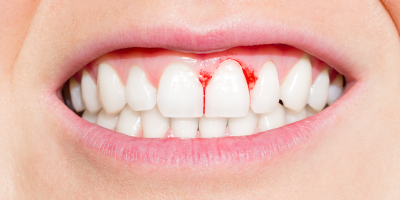
It’s never normal to bleed your gums!
Bleeding from the gums is one of those situations that, although common, cannot be ignored. Take note that at some point, it may even integrate the batch of periodontal diseases, so it is important to know how to avoid such a fact!


