Gingivectomy recovery: healing, care, before and after
Most people come to this topic with a very concrete doubt that today we will try to clarify. Interestingly, it’s not about the name of the procedure, nor is it even about aesthetics.
The real question is simple: How is gingivectomy recovery?
How long does it take to heal, if it hurts, when you notice a difference and, above all, if the result becomes natural!
Because the gum, contrary to what many people think, is not an accessory. In fact, it defines half of the smile and directly influences oral health.
When there is excess gum, persistent inflammation or an irregular contour that unbalances aesthetics, and gingivectomy may be the appropriate treatment.
If we look, it is small in execution but with real impact on smile and comfort.
Contents approached
What it means to recover from a gingivectomy
Recovery is not just “going through the postoperative period”. Recovering means allowing the gum to heal stably, without inflammation and with a natural contour.
In most cases, gingivectomy recovery is a well-tolerated process. In the first days there may be some sensitivity and a different sensation when brushing or eating, but the process tends to be progressive and controlled when there is adequate clinical follow-up as provided in A Clínica.
- The gum heals relatively quickly, but the final aesthetic result is not immediate. As with any living tissue, there is a time of adaptation.
Consult online the treatment plan is possible in A Clínica!
Whether in a gingivectomy or any other dental or aesthetic treatment carried out at our dental practice in Vila Franca de Xira, we seek that the service is close and respond to the needs of our clients 24 hours a day.
In the post-gingivectomy follow-up, the clinic has a reserved area where you can consult treatment plans, for example.
With the NoviSmile application our patients can also:
- Request appointment appointments anytime
- Confirm or unbook appointments
- receive important notifications
- Access your medical history and current account
- Consult other treatment plans
- Download documents, clinical reports, images and attendance statements
- Evaluate your queries, among many other features
How long does it take to heal your gums
One of the most common and difficult questions to answer is about recovery time.
Overall, initial discomfort improves throughout the first week.
However, the time of complete gum healing, in the aesthetic sense and contour stability, can take a few weeks.
This does not mean complication or that it is something bad. It means tissue maturation, that is, the success of treatment.
The smile naturally adjusts, and the gum line becomes more defined with time.
Or that it’s normal to feel in the first few days
- local sensitivity
- Slight temporary alteration to the shape of the gingiva
Many people describe this phase as a period of adaptation: it is not an intense pain, but a greater awareness of the treated area.
The most important thing is to realize that the postoperative period is part of the treatment, and it is likely that these situations will occur.
Care that makes a difference in recovery
The postoperative gingivectomy is what determines whether the outcome will be only “good” or adequate and lasting.
But there is a way to naturally speed up the process. Recovery is faster and more predictable when there is careful hygiene, control of plaque and respect for the clinical guidelines given by our specialists.
Gingivectomy is not a substitute for oral health habits. On the contrary: it requires even more stringency during the first few weeks to ensure that the gum heals without inflammation.
This is also why protocols like GBT can be useful in monitoring before and after.
Gingivectomy before and after: when you notice the change
Gingivectomy research before and after is frequent because people want to know if the difference is visible.
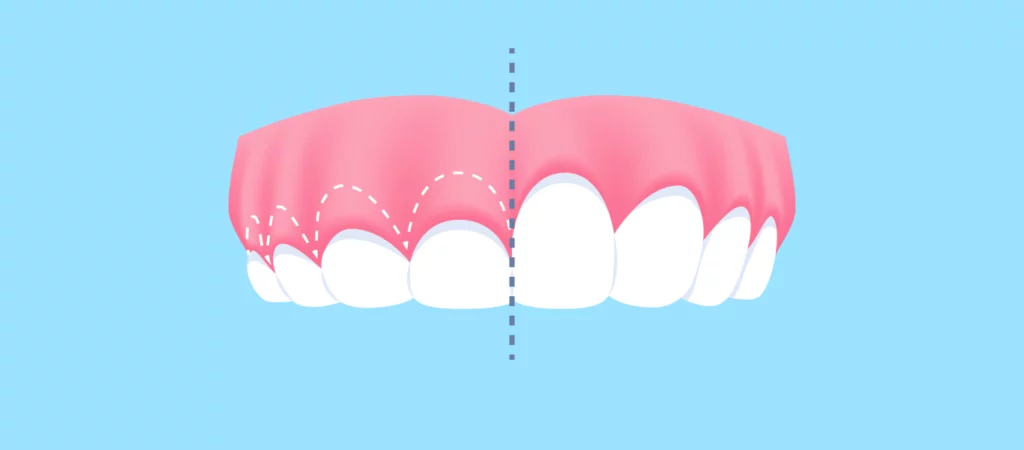
In most cases, what changes is not something artificial. It’s proportion.
Teeth that seemed shorter become more balanced, the gum line gains symmetry and the smile passes to convey lightness.
The goal is not to “cut off gum”. It’s to restore harmony. See here a real case.
When indicated in the gingival smile
Not all cases of gingival smile are the same.
Sometimes, excess gum is the main factor. In other situations, there are bone or functional components that require another type of approach.
Therefore, the treatment of gingival smile always begins with rigorous periodontal diagnosis, not impulsive decisions.
Recovering is consolidating a process in gingivectomy
Gingivectomy recovery usually proceeds without complications, but any persistent pain, prolonged bleeding, or worsening of swelling should be assessed.
Gingivectomy can transform a smile, but beware of overdoing it. Transforms because it returns balance, health and proportion.
When indicated, after a thorough evaluation and definition of the treatment plan performed in A Clínica, gingivectomy is a conservative, safe and highly effective procedure.
In fact, the gum is not just aesthetic. It’s health. And recovery is the moment when this result consolidates and naturalness appears.
Schedule your gingivectomy at the clinic.
You may be interested in:

Cosmetic dental check-up: what you should evaluate before bleaching your smile
Will you bleach your teeth? Without a dental beauty check can ignore inflammation, wear or hidden cavities. Know what should be evaluated first.

Shame of smiling: when aesthetics are a sign of oral health to be treated
Hiding your smile can be a sign of plaque, bad breath, or gum inflammation. Find out what causes the shame of smiling.

Movember: taking care of the mouth is taking care of the male body and oral health
Male oral health is linked to heart, energy and even performance. In this Blue November, know why dental care for men is more than aesthetic and is real prevention.