
Constant headache?
The source may be in your smile, not in your head

Beat lightly, slightly, like the one who calls for me.
Will it rain? Will it be people?
People are certainly not
and the rain doesn’t hit like that. (Augusto Gil)
Who do you think is coming? There are pains that arrive without warning and without knocking at the door. They settle slowly, with that insistent weight on the temples, the sensation of tightness in the head and fatigue that seems to have no origin.
When constant headache is part of our routine, we look for answers: from the neurologist, from the ophthalmologist; we do tests; we take painkillers. Still, nothing changes….
But what if the origin is not in the head?
What if the smile has been sending warning signs for a long time?
At A Clínica Dr. Pedro Mota, we have followed many patients who found that the pain relief was not in a pill box, but in the balance of the mouth, as you can discover throughout the article.
In fact, occlusion, that is, the way teeth fit and jaws articulate, may be the starting point of pain that has dragged on for years.
Contents approached
When the body speaks, the smile responds
The human body is like an orchestra and the organs relate to each other so that the whole organism functions in harmony. The temporomandibular joint (TMJ), which connects the jaw to the skull, is surrounded by muscles and nerves that communicate with the head, neck, and even posture.
When the bite is misaligned, these muscles work under constant strain. It’s like living in permanent tension and the result, obviously, can only be pain.
The headache is no longer just a symptom. It becomes a message: something in the body structure is not fully functioning. When this happens, and if necessary, in the Clinic we work together with physiotherapists and osteopaths to treat ATM and end pain.
On the other hand, we gain a problem when we try to silence discomfort with medication, this imbalance continues to grow. The jaw compensates, the muscles of the face contract, the TMJ ignites and ‘voilá‘, the cycle of pain repeats.
The science behind discomfort
Let’s resort to an analogy, on a door, when a hinge is poorly placed, in addition to the door not closing well, it ends up being damaged or even broken hinges that are good, by overload.
Now, let’s take the jaw as a thin and precise hinge. When this hinge is misaligned, the whole system adapts and the body pays the price.
- Muscles in chronic tension: the masseter and temporal (the same ones that help chew) are directly linked to the temples.
- Sensitized nerves: inflammation in the TMJ can radiate to the head, neck and shoulders.
- Silent wear, curiously, this pain often relieves when the muscles relax or when the occlusion is corrected.
- Conclusion: If you have symptoms such as flare-ups, jaw blockages, or tinnitus, there may be a connection to the TMJ.
But I only have a constant headache...
It is precisely this phrase that we often hear at our dental clinic in Vila Franca de Xira. And it is the turning point.
During the assessment, the patient realizes that the headache is only a reflection of something deeper, such as an occlusion that has gone unnoticed for years, i.e. there is a relationship between the malocclusion and the headache.
For the diagnosis of malocclusion headache, we use state-of-the-art technology that allows us to precisely analyze the relationship between teeth, jaws and joints.
This is how we detect invisible microvoltages, small deviations that, repeated daily, create a silent and persistent pain.
Therefore, a misaligned smile may not just be an aesthetic issue, but rather it is an imbalance that the body tries to correct, and which often manifests itself in pain (which can become chronic).
According to a recent MD.Saúde news headaches and toothaches are in the ‘top ten‘ of most painful diseases in humans. In practice we can confirm this even with our patients who report the suffering they bring.
A new way of understanding pain
Pain is often seen as an enemy, but it is actually the first sign of body wisdom.
She does not appear to punish, she appears to warn.
However, living with pain is not normal. Sometimes the first step to freedom is looking in the mirror and asking, “What if my smile is asking for help?”
Listen to what your body is trying to say
If you’ve been living with a constant headache for too long, maybe it’s time to act:
look not just where it hurts, but at what causes the pain.
At A Clínica Dr. Pedro Mota, We believe that health begins with balance. A functional smile is also a body at peace, without chronic orofacial pain or TMJ headache.
Don’t delay this step any longer and schedule an orthodontic assessment and find out if your headache may be caused by the smile. Because sometimes, what hurts in the head is born in the mouth!
You may be interested in:
Gingivectomy recovery: healing, care, before and after
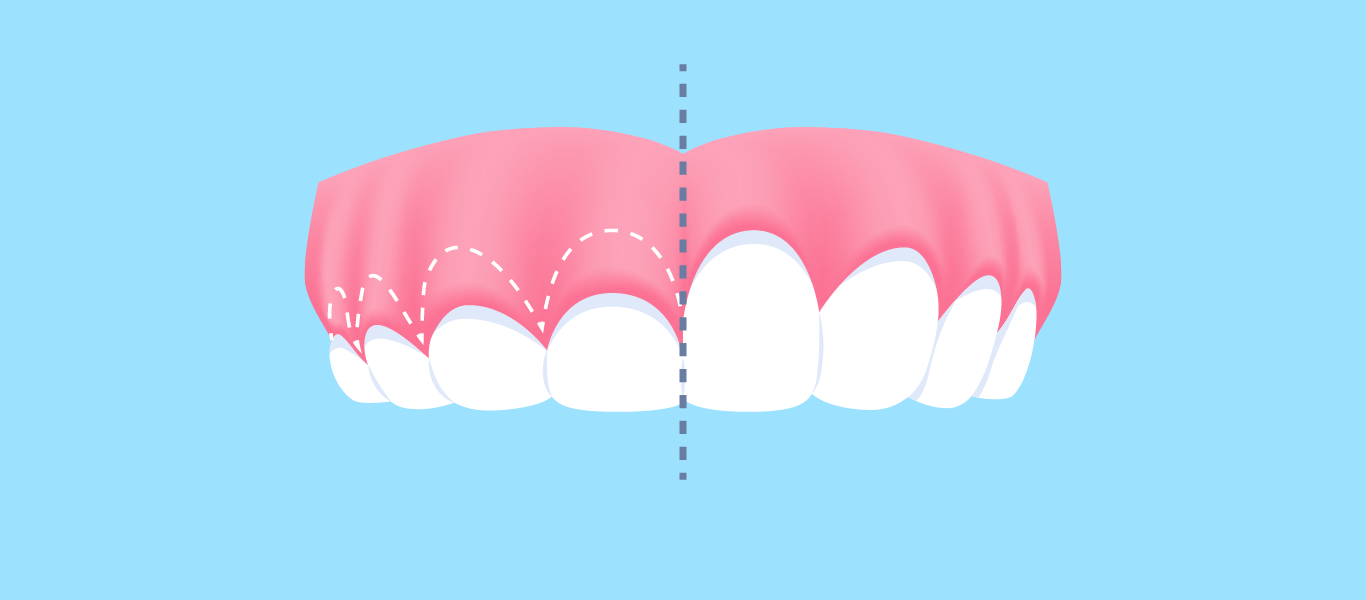
Gingivectomy recovery: what is normal to feel, how long does healing last and when you notice the difference in smile.

Shame of smiling: when aesthetics are a sign of oral health to be treated
Hiding your smile can be a sign of plaque, bad breath, or gum inflammation. Find out what causes the shame of smiling.


