


Tooth removal included: when should it be treated and which signs should not be ignored
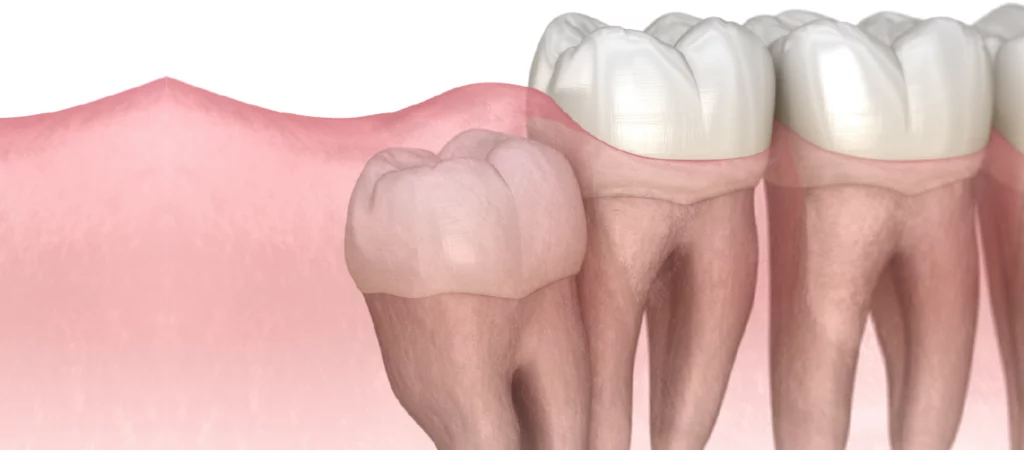
Not all dental problems start with severe pain as when even tooth removal is necessary.
In many cases, everything begins almost imperceptibly. A slight pressure while chewing. A strange sensation on the gum. A discomfort that appears for a few weeks and then disappears again. Until the day when it is no longer possible to ignore.
This is precisely how many patients discover the existence of an included tooth.
We also add, most of the time, that the problem had been present for years.
Contents approached
What is an included tooth?
An included tooth is a tooth that has failed to grow properly and remains wholly or partially retained in the bone or gum.
Although the teeth of siso are the most well-known cases, this situation can also affect canines and other permanent teeth.
In some patients, the tooth tries to erupt in an incorrect position, a phenomenon known as ectopic eruption. In other situations, there is simply not enough space in the dental arch to allow normal birth of the tooth.
The problem is that the body does not always give immediate signals. And that is precisely what makes these cases so treacherous.
When do the first symptoms appear for the tooth removal included?
Many people live for a long time with a stuck tooth in the gum without realizing the true source of discomfort.
It is common for patients to arrive at the clinic after months of avoiding chewing from one side or experiencing minor recurrent inflammations that eventually disappear temporarily.
The most common symptoms include:
- Pressure on the gum
- Localized pain
- Recurrent inflammation
- Difficulty in sanitizing certain areas
- Malocclusion
- Sensitivity to chewing
- Sensation of jaw tension
In some cases, the problem is discovered during orthodontic treatments, when the tooth itself begins to compromise the dental alignment and stability of the arch.
Did you know that in A Clínica, after evaluation at the first consultation, the extraction of the included teeth is one of the treatments that people most refuse?
This is because they have no discomfort or pain. When the latter arises, it gives rise to an emergency consultation.
In this case, our patients confide: “I should have had the siso tooth out right away instead of having this horrible pain.”
6 reasons not to ignore: symptoms of tooth included
One of the most frequent mistakes is to assume that if there is no severe pain, then there is no real problem.
But many included teeth evolve silently for years while causing progressive changes in the structures around them.
Depending on the position of the tooth, the following may appear:
- Recurrent gum infections
- Damage to neighboring teeth
- Cyst formation
- Root resorption
- Worsening of dental misalignment
- Persistent inflammation
That is why the American Dental Association (ADA) warns for proper follow-up of included teeth due to the risk of future complications.
In fact, in some patients, the situation is only identified when discomfort finally begins to interfere with simple everyday activities such as eating, sleeping or speaking normally.
How is the removal of an included tooth done?
Oral surgery has evolved significantly in recent years.
Today, planning is much more precise, as you can experience in our dental clinic, just 20 minutes from Lisbon, allowing us to anticipate the exact position of the tooth, assess the proximity of nerves and reduce surgical trauma whenever possible.
Before the procedure, a detailed clinical and imaging assessment is performed to understand:
- the position of the tooth
- degree of inclusiveness
- proximity to important anatomical structures
- the surgical complexity of the case
In many of our patients, the greatest fear is associated with the idea of pain, but what you will feel is a small bite from anesthesia and “a little less judgment,” as they say in slang.
In the post-treatment at home, if the care of the Dentist follows the rule, everything will be fine. For the less courageous, conscious sedation came to be a great help, as it reassures the patient in order to cooperate in the intervention.
With modern techniques and proper planning, the procedure tends to be much more comfortable, predictable and controlled.
In the daily reality of A Clínica is one of the most performed procedures and we risk saying that it is ‘peanuts’ for the Dr. Pedro Mota.
Is recovery often difficult?
In most cases, no.
It is normal to have some edema, sensitivity or discomfort in the first few days, especially in more complex situations. Still, when treatment is carried out in time and the patient follows postoperative indications correctly, recovery usually proceeds smoothly.
According to the NHS, most people can gradually return to routine within a few days of removal.
Many patients even admit after surgery that the previous discomfort was much more uncomfortable than the procedure itself.
How early evaluation makes a difference
There are dental problems that rarely improve on their own.
On the contrary. The more time they spend without follow-up, the greater the future complexity of treatment (and the monetary outlay, as we have seen here).
That is precisely why preventive assessments remain crucial, even when symptoms seem minor or occasional.
In many cases, early identification of a single tooth allows for simpler, less invasive treatment of retained teeth with significantly faster recoveries.
Removal of teeth included is possible with properly planned oral surgery
Every case is different. The position of the tooth, the patient’s age, clinical history and relationship with other dental structures directly influence treatment.
Therefore, oral surgery in Vila Franca de Xira is carefully planned and integrated into a global vision of the patient’s oral health.
In certain situations, the absence of treatment may end up compromising dental stability and lead to more complex problems in the future, such as missing teeth.
If you feel persistent pressure on your gums, discomfort when chewing or have been informed that you may have a tooth included, an expert assessment can help prevent future complications and allow for simpler and more comfortable treatment.
In the A Clínica Dr. Pedro Mota, each case is analyzed individually, with special attention to a rigorous diagnosis, clinical planning and close follow-up of the patient.
Schedule your appointment in the clinic now.
Frequently asked questions about included teeth
Not always. The decision depends on tooth position, symptoms, risk of complications and impact on oral health.
Yes. In some cases, it can exert pressure on neighboring teeth and interfere with orthodontic treatments.
The procedure is performed with local anesthesia and modern and appropriate techniques that help minimize discomfort and accelerate recovery.
Recovery varies from case to case, but most patients gradually return to routine over the following days.
You may be interested in:

Constant headache? The source may be your smile, not your head
The constant headache may not come from the mind, but from the smile. Discover how malocclusion and temporomandibular joint (TMJ) influence well-being.
I’m getting a siso tooth, do I need to remove it?
It hurts. Inconvenient. It comes when you least expect it and seems to want to rule alone in your mouth. When he is born, there is a question that sets in: “Do I really have to remove the tooth from the siso?