


Back to workouts? A personalized mouthguard protects more than just your smile
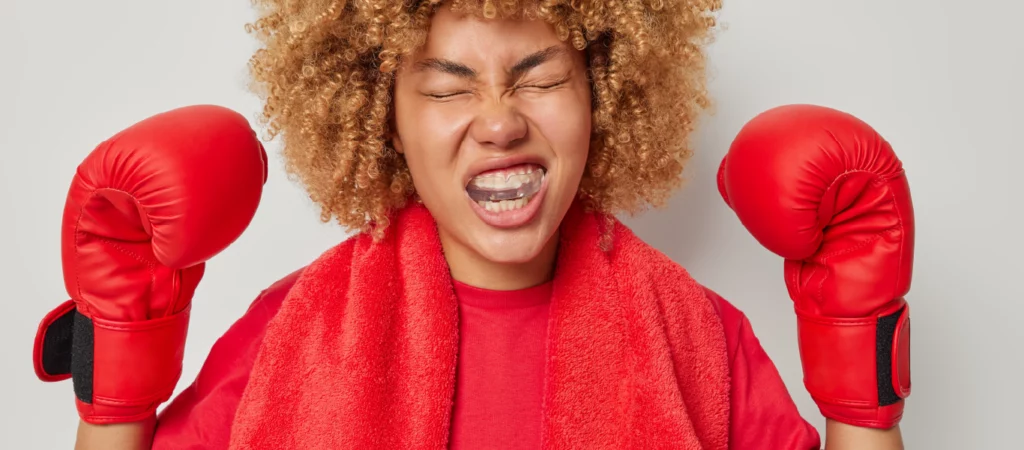
The return to training often brings new goals, more intensity and a desire to catch up. But it can also increase exposure to falls, collisions, elbows or unexpected impacts. When there is a risk of contact with other athletes, equipment or surfaces, a personalized mouthguard can be an important part of protection.
Although it is often associated with modalities such as boxing, rugby or martial arts, the mouthguard can also be recommended for other activities, as we will see later in this article, where a trauma to the mouth may occur.
Its function is not limited to preserving the appearance of the smile. Properly tailored tooth protection helps reduce the risk and severity of injury to teeth and oral tissues by protecting essential structures for chewing, speaking, and smiling.
Contents approached
What can happen during a mouth impact?
A dental injury in sports can happen in a fraction of a second. A fall, contact with another athlete or the impact of a ball can directly hit teeth, lips, tongue or dental support structures.
Depending on the intensity and direction of impact, the following may occur:
- Dental fractures or fissures;
- Dislocation of one or more teeth;
- complete loss of a tooth;
- Cut our lips, cheeks or tongue;
- Injuries to the gum and tissues supporting the teeth;
- Damage to restorations, crowns or orthodontic appliances;
- Trauma to the bones of the face or jaw.
Not all of these accidents can be prevented. However, using a properly adjusted sports mouthguard can help absorb and distribute some of the impact energy by reducing its concentration on a single tooth or a specific area of the mouth.
It is in this sense that the American Dental Association (ADA) recommends the use of well-adapted mouthguards in sports and recreational activities with significant risk of dental or orofacial trauma.
A sports mouthguard protects more than your teeth
When talking about dental protection in sports, it is natural to think first of the anterior teeth, as they are more visible and often exposed to impact. However, the protection provided by a mouthguard goes beyond this area.
The device creates a resilient surface over the dental arch and can decrease direct contact of teeth with soft tissues. In this way, it helps to reduce the risk that teeth themselves will cause cuts to the lips, cheeks or tongue during a shock.
It can also help protect existing dental restorations and reduce direct force transmission between the arches. This is especially relevant for athletes with previous dental treatments or using orthodontic appliances.
However, it is important to clarify a point that is common to raise doubts: the mouthguard should not be presented as a guarantee against concussions or head injuries. The scientific evidence is consistent for reducing dental and orofacial injuries, but remains less conclusive for preventing concussions.
What is the difference between a custom tooth protector and a generic model?
Not all mouthguards have the same fit. Prefabricated models have standardized sizes and are not adapted to individual anatomy. For this reason, they may exhibit less restraint, move during the activity or require the athlete to keep their teeth closed to hold them.
There are also thermoforming protectors, known as “warm and bite” models. These soften in hot water and are shaped by the user. Although they allow some adaptation, the result depends on the quality of the product and the correct execution of the instructions.
The custom mouthguard is made from the athlete’s oral anatomy. Its confection can rely on a dental impression or the digital recording of the mouth, allowing to adapt the device to the teeth and the surrounding structures.
This customization can provide:
- Greater stability during movement;
- Better adaptation to the dental arch;
- Increased comfort during extended periods;
- Less need to clench the teeth to keep it in place;
- Easier to breathe and communicate;
- Thickness appropriate to the risk of the sport played.
- The best protector is not just one that has good technical features. It is one that is properly adapted and which the athlete consistently uses during training and competitions.
In what modalities can it be recommended?
The use of a sports mouthguard should be considered whenever there is a risk of contact, collision, fall or impact with moving objects.
-
boxing and other combat sports;
-
rugby;
-
hockey;
-
handball;
-
basketball;
-
football;
-
water polo;
-
cycling and mountain biking;
-
skate and roller skating;
-
gymnastics;
-
racquet sports;
-
riding.
The risk does not exist only in competition. Many accidents happen during workouts, when exercises become more intense or when athletes are less focused on the possibility of impact. Therefore, protection must accompany the practitioner in all relevant exposure situations.
The need and type of protector should be assessed by a specialist considering the modality, training frequency, contact level and oral condition of each person.
Should children and young people also use protection?
In children and adolescents, the decision requires special attention. The mouth is developing, milk teeth and permanent teeth can coexist and the dental position may change over time.
A protector that served properly at the beginning of a season may no longer present an adequate adjustment some months later. Therefore, it should be checked regularly and replaced when there are changes in growth, dentition or orthodontic treatment.
The loss or fracture of a permanent tooth at a young age may require follow-up and treatment for many years. Prevention is therefore particularly important at this stage.
Is it possible to use mouthguard with orthodontic device?
In many cases, yes. However, the device must take into account the presence of brackets, orthodontic arcs, and predicted tooth movement.
An impact on the lips may press them against the components of the appliance and cause cuts or other injuries. The protector may create an additional barrier, but it should not compress the appliance or interfere with treatment.
As the position of the teeth changes throughout orthodontics, adjustment must be monitored. A protector that becomes too tight, deformed or unstable should be reassessed.
How to care for a sports mouthguard?
Hygiene and maintenance care help keep the device in good condition.
After each use, the tooth protector must be washed as instructed and allowed to dry before storage. It should be kept in a ventilated box, protected from heat sources and direct sun exposure.
Too hot water can deform certain materials and compromise the fit.
Should be evaluated or replaced if it shows tears, cracks, or deformations; rough or sharp areas; significant change in color or odor; loss of retention; discomfort during use; changes in dentition or orthodontic appliances.
Even when it seems to be in good condition, adaptation can change. The regular assessments as we do in A Clínica allow us to confirm whether the protector is still suitable for the mouth and the modality practiced.
Before returning to training, assess your protection
Shin guards, helmets or other safety equipment are part of the preparation for many athletes. When there is a risk of orofacial trauma, the personalized mouthguard should also be considered.
A personalized mouthguard does not transform a contact mode into a risk-free activity, nor does it completely eliminate the risk of dental trauma in sports. It can, however, help reduce the incidence and severity of certain dental and oral injuries while providing better fit and comfort.
At the Oral Health in Sports consultation we held at our dental clinic in Vila Franca de Xira, just 20 minutes from Lisbon, the dentist evaluates dentition, existing treatments, the modality practiced and the level of exposure to impact. Based on this assessment, it can indicate the most appropriate solution to train and compete with greater protection.
If you are back to training, this may be the right time to confirm that your smile is also ready. Schedule your appointment in A Clínica.
Seek expert help
Will be evaluated by the specialist dentist in our clinic. We listen to your needs and plan your treatment according to your wishes. In our clinic, we do not sell treatments, we return smiles.
We plan the smile, clarify your doubts and execute with precision.
You may be interested in:
The oral health of athletes also plays and can be decisive in performance!
Athletes’ oral health can be impaired by the intake of energy/food supplements (e.g. creatine). Take care of your performance!