How to clean invisible aligners?
Learn how to maintain the effectiveness, transparency and safety of orthodontic treatment
The use of invisible aligners requires more than discipline; it requires strict attention to hygiene, handling and respect for the material. Therefore it is extremely important to know how to clean the invisible aligners.
These devices (made of medical grade thermoplastic polymers) rely on their integrity to exert accurate and predictable orthodontic forces.
However, improper cleaning practices and inappropriate daytime habits compromise transparency, increase bacterial risk and may even alter the mechanical behavior of the aligner.
With today’s article, we try to explain in an objective and grounded way the essential care recommended by experts and aligned with the guidelines of the famous brand Smilers from Biotech Dental, which markets a specific cleaning kit, ensuring a safer treatment, Hygienic and effective.
Contents approached
The science behind invisible aligners hygiene
Several recent studies, many of them published in Polymers (MDPI), demonstrate that abrasive methods such as toothpaste, hard brushes or hot water alter the surface and mechanical stability of aligners.
This microscopic wear increases the roughness of the material, favors bacterial adhesion, accelerates the loss of transparency and can compromise the adaptation of the device to the teeth.
In parallel, the maintenance of poorly cleaned aligners favors the formation of biofilm, with potential to cause caries, gingivitis, halitosis and oral inflammation.
- The correct cleaning is therefore not a detail: it is a clinical need!
How to clean invisible aligners properly?
Care with invisible aligners
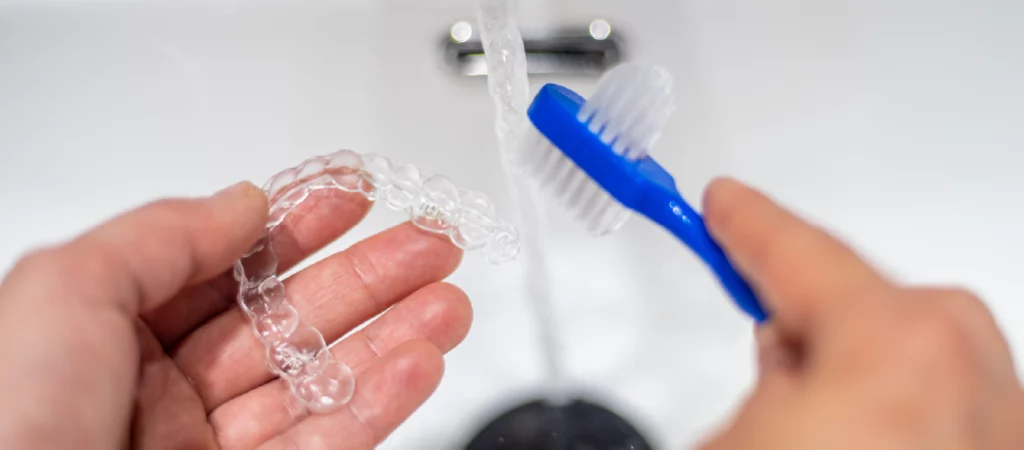
- Whenever the user removes the aligners, whether to eat, drink something pigmented or sanitize their mouth, they should rinse them immediately with cold or warm water. This prevents the saliva from drying out and forming deposits that are difficult to remove.
The method and use of the kit recommended by Smilers, explained by our oral hygienist, includes the use of:
✅Neutral liquid soap (soft, without abrasives or harsh fragrances).
✅Soft bristle brush.
✅Warm water (never hot).
This combination allows you to remove fresh bacterial plaque without damaging the polymer. The brushing should be delicate, in circular movements, ensuring that all surfaces (internal and external) are clean.
Should never be used:
❌Traditional toothpaste (abrasive).
❌Acid solutions, bicarbonate or alcohol.
❌Household detergents.
❌Água quente (risco real de deformação).
It is essential to eliminate any soap residue, ensuring that the aligner maintains a smooth, even and transparent surface.
Once or twice a week, it is recommended to use specific cleaning pads for aligners. These solutions release invisible deposits, control odors and contribute to the maintenance of microbiological hygiene, provided they are compatible with the material used.
Essential care: always remove the aligners to eat!
This is, clinically, the most frequent error among users of invisible aligners, besides being one of the most compromising results.
!️Why is it mandatory to remove them?
- Risk of deformation:
The material is not designed to withstand chewing; pressure alters the structure and impairs orthodontic planning. - Heat:
Hot foods and beverages can deform the polymer. - Pigmentation:
Coffee, tea, red wine, sauces and soft drinks quickly and irreversibly stain the aligner. It’s the same with your own teeth, as we have seen here, but you can treat stains on your teeth with a ‘revolutionary spa’. - Microbiological safety:
Eating with aligners placed traps food debris between the tooth and device, which creates an accelerated bacterial growth environment.
How to proceed correctly in the hygiene of aligners:

- Always remove before any meal or snack.
- Keep the aligners in their own box.
- After eating, brush your teeth; if not possible, at least rinse your mouth.
- Rinse the aligners before replacing them.
This behavior protects oral health, preserves transparency and increases treatment predictability.
Habits that undermine durability and transparency
Some behaviors should be avoided, even if they seem harmless:
❌Drink pigmented drinks with aligners placed.
❌Keep aligners exposed to heat (car, pocket, sun).
❌Use whitening pastes or rigid brushes.
❌Transport them in napkins (often end up in the trash).
❌Keep them out of the box, exposing them to contamination.
Betting on the prevention of these bad habits prolongs the life of each aligner and keeps the aesthetic invisible.
Oral hygiene before replacing aligners
The placement of aligners on poorly cleaned teeth exponentially increases the risk of caries and gingival inflammation. Therefore:
✅Full brushing should be performed before replacing the aligner.
✅Flossing is highly recommended.
✅Colourless rinses may complement, as long as they do not come into prolonged contact with the aligner. Proper product selection is important for cleaning invisible aligners.
There is a line that separates: wear invisible aligners and use them correctly!
Cleaning invisible aligners is not a routine gesture: it is a responsibility that directly influences the effectiveness, comfort and final result of orthodontic treatment.
When the patient respects the basic care we saw earlier – how to remove to eat, clean with mild soap, avoid abrasives, protect from temperature and reinforce oral hygiene – it preserves not only the transparency of the aligner, but also the health and predictability of dental movement.
In a context where the invisible aligners are an option for many, it stands out who understands that the excellence of the smile depends as much on technology as on how you take care of them.
Do not waste any more time and schedule your appointment for the placement of your invisible aligner in a dental clinic with evidence given in Vila Franca de Xira. If you need to make the replacement of the invisible aligner because it is damaged or stained we can also help.
Enjoy and see a testimony in the first person of Dr. Pedro Mota.
You may be interested in:

Cosmetic dental check-up: what you should evaluate before bleaching your smile
Will you bleach your teeth? Without a dental beauty check can ignore inflammation, wear or hidden cavities. Know what should be evaluated first.

Steps to enhance the smile with facial aesthetics without losing naturalness
Improving the smile without exaggeration is possible, as you will notice in this article where we talk about facial and dental aesthetic treatments designed for demanding adults who value authenticity.
How tobacco affects your teeth. What you can do before it’s too late
Find out how smoking affects your teeth and what you can do to get your smile back. From bleaching to aesthetic rehabilitation, current technology returns color, health and self-esteem.